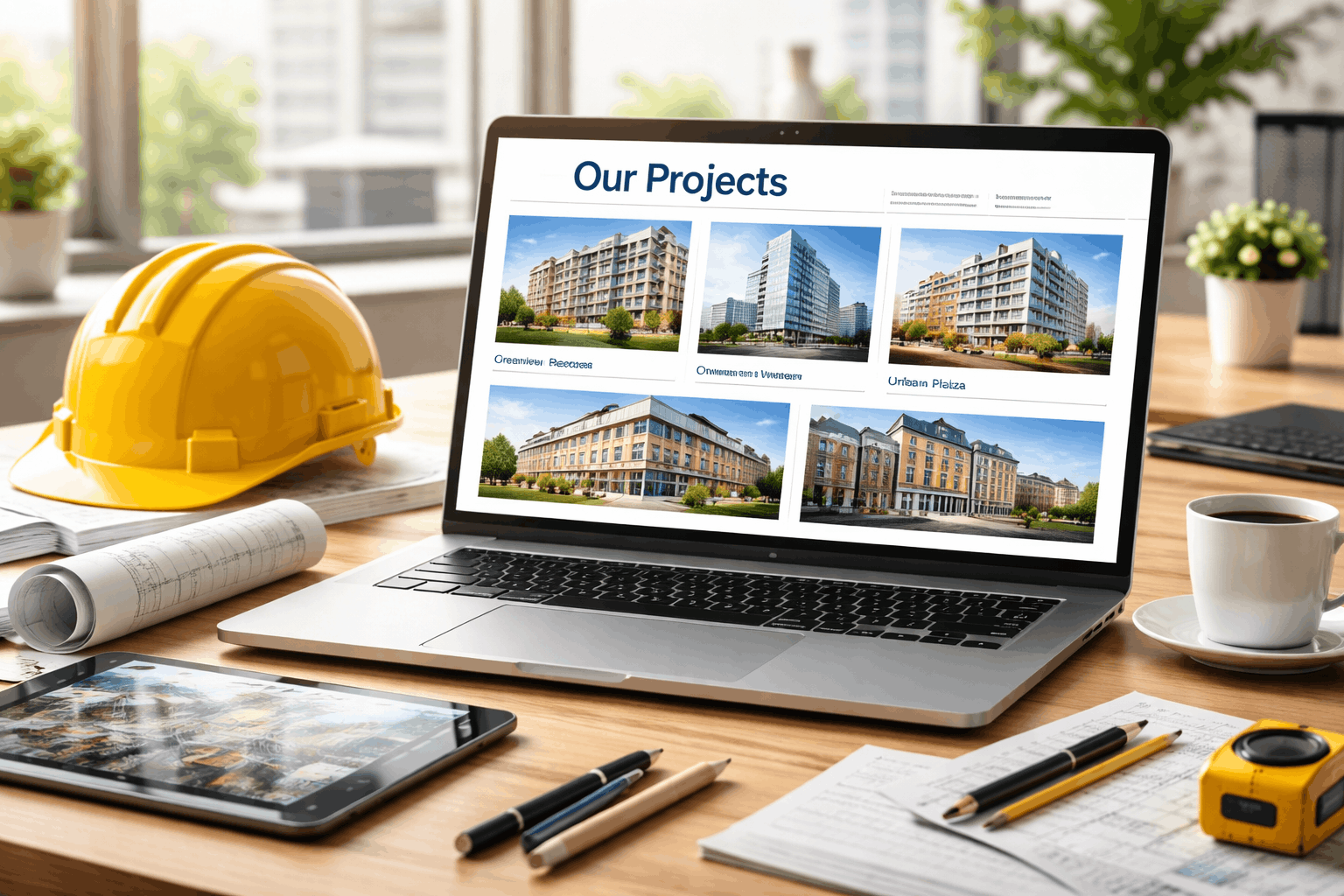
Construction firms showcase projects online through professional portfolio websites, social media platforms like Instagram and LinkedIn, video content on YouTube, case studies, drone photography, and client testimonials. According to the Construction Marketing Association, 82 percent of construction project research now begins with an online search, which means a firm’s digital project portfolio is often the first impression a potential client gets.
Why Construction Firms Need to Showcase Projects Online
Not long ago, construction companies relied almost entirely on word of mouth, referrals, and printed portfolios to win new work. That model still works, but it is no longer enough on its own. The way project owners, developers, and procurement teams evaluate contractors has changed significantly over the past decade, and most of that change has happened online.
According to a BuildOps survey, one-third of U.S. construction companies actively use Facebook to engage with potential clients, and 63 percent use video platforms like YouTube for content sharing. These numbers reflect a broader shift in how the industry markets itself. Firms that present their completed work in a compelling, professional, and accessible way online are consistently outperforming those that do not.
Deloitte’s Global Powers of Construction report projects that the global construction market will grow from 11.39 trillion USD in 2024 to 16.11 trillion USD by 2030. In a market of that size, standing out through strong digital project presentation is not a marketing nice-to-have. It is a competitive necessity.
1. The Project Portfolio Website
A dedicated portfolio section on a construction firm’s website is the foundation of everything else. According to the Associated Builders and Contractors, construction websites that feature detailed visual portfolios see 40 percent higher engagement rates than those without one. That single stat alone explains why portfolio pages have become a standard feature on virtually every serious contractor website.
A well-built portfolio page does more than display photographs of completed buildings. It tells the story of each project. The best construction portfolio pages include the project name and location, the client or project owner, the scope of work, key challenges encountered and how they were resolved, the final delivery timeline and budget status, and high-quality photography from multiple stages of the project.
Firms like Bechtel Corporation and PCL Construction set a strong benchmark here. Bechtel’s website organizes projects by sector and geography, making it easy for a prospective client in any industry or region to find directly relevant work. PCL maintains an online library of project profiles with detailed write-ups, photography, and downloadable case studies. These approaches work because they answer the questions a potential client is already asking before they pick up the phone.
Mobile Optimization Is Not Optional
According to Google’s construction industry data, 67 percent of construction-related searches now happen on mobile devices. A portfolio that looks great on a desktop but breaks on a phone is actively costing firms leads. The Construction Marketing Association found that construction websites with clear, mobile-friendly calls to action convert up to 25 percent better than those without.
2. Photography and Visual Documentation
Construction is one of the most visual industries that exists. A completed commercial building, a well-executed renovation, or a complex infrastructure project all carry enormous visual impact. Professional photography is the single most powerful tool a construction firm has for showcasing that work online.
This does not mean hiring a photographer once at project completion. The firms that do this best document their projects throughout the entire construction lifecycle. Progress photography from groundbreaking through structural work to the finished product gives potential clients a much richer picture of a firm’s capability and attention to detail than a single hero shot of the finished building ever could.
Drone Photography and Aerial Footage
Aerial photography has become one of the most effective ways construction firms showcase large-scale projects online. Drone footage gives viewers a perspective that ground-level photography simply cannot provide, particularly for infrastructure projects, large commercial developments, or complex site layouts. According to BigRentz, drone mapping is one of the emerging construction technologies companies are most actively investing in, and its use in marketing has grown alongside its use in project management.
Firms like Turner Construction and Skanska regularly use drone footage in their project showcases, posting aerial walkthrough videos on their websites and YouTube channels. This kind of content performs well across all digital platforms because it is genuinely impressive to watch and it communicates scale and complexity far more effectively than static images.
3. Case Studies and Project Write-Ups
Photography gets people interested. Case studies are what actually convince a sophisticated client that a firm is right for their project. A well-written project case study goes beyond what a project looks like and explains how it was delivered.
The Content Marketing Institute’s B2B Construction Marketing Report found that in-depth case studies and detailed project documentation are among the most effective content formats for establishing credibility with potential clients. This makes sense when you consider who is actually evaluating construction firms for major contracts. These are procurement managers, developers, and project owners who are making significant financial decisions. They want evidence of competence, problem-solving ability, and reliable delivery, not just good photography.
An effective construction case study covers the project brief and initial scope, any significant challenges that emerged during the project and how the team addressed them, subcontractor and materials management details where relevant, sustainability or green building certifications achieved, and the final outcome measured against the original project goals. Firms like AECOM publish detailed project profiles on their websites that follow exactly this structure, and they are consistently cited by industry observers as a benchmark for professional project presentation.
4. Social Media Platforms
Different social media platforms serve different purposes for construction firms, and understanding which platform does what is the key to using them effectively rather than just being present everywhere at once without a clear strategy.
Instagram is the strongest platform for visual project showcasing in the construction industry. Its format is built for high-quality images and short videos, making it ideal for sharing progress photographs, completed project reveals, and behind-the-scenes footage from active job sites. According to Cross and Crown Digital, 93 percent of companies across industries have landed new customers through video content on social media, and construction firms are no exception to this trend. The key on Instagram is consistency and quality. Firms that post regularly with professional photography, clear captions, and relevant hashtags build audiences that include developers, architects, and potential clients.
LinkedIn serves a different but equally important role. It is the primary B2B networking platform and is most effective for establishing professional credibility and thought leadership rather than direct visual showcasing. According to Cross and Crown Digital, over 8,000 construction companies compete for attention on LinkedIn alone. Firms that use it well share project milestones alongside business insights, team achievements, and industry commentary. Major firms like Fluor Corporation maintain active LinkedIn presences that combine project announcements with broader industry perspective, which attracts both clients and talent.
YouTube
YouTube is the best platform for long-form video content like project time-lapses, completed building walkthroughs, and virtual tours. Because YouTube is both a social platform and a search engine, project showcase videos uploaded there can generate organic search traffic for years after they are posted. The Construction Marketing Association’s research shows that construction firms using YouTube for project content consistently report higher engagement from serious prospects than those relying on short-form video alone.
Facebook remains relevant for reaching residential clients and local communities. The BuildOps survey data showing that one-third of U.S. construction companies actively use Facebook reflects its continued usefulness for local contractor marketing, community engagement, and project announcements that target homeowners or regional development audiences rather than corporate clients.
5. Video Content and Time-Lapse Photography
Video has become one of the most important formats for construction project showcasing, and time-lapse photography in particular has emerged as a signature format for the industry. A well-produced time-lapse of a major construction project compressed into a two or three minute video communicates the scale of the work, the complexity of the operation, and the competence of the firm in a way that photographs and written descriptions never quite match.
Peritus Marketing, which works with construction and engineering companies, notes that project showcase videos and time-lapses are particularly impactful because potential clients want to see your work in action rather than just being told about it. This is especially true for large general contractors competing for complex commercial or infrastructure contracts where the decision-maker wants tangible evidence of a firm’s execution capability.
Beyond time-lapses, virtual building walkthroughs have grown significantly in use. These are video tours of completed projects, typically filmed with a gimbal camera system, that guide the viewer through the finished space from entrance to completion. They work exceptionally well for interior construction projects like commercial fit-outs, healthcare facilities, or high-end residential builds where the quality of the interior work is central to the firm’s value proposition.
6. Client Testimonials and Reviews
Third-party validation is one of the most powerful elements in any construction firm’s online project showcase. Photographs and case studies tell a firm’s story about itself. Client testimonials tell a prospective client what it was actually like to work with that firm on a real project, and that is a very different kind of evidence.
According to Inner Spark Creative, leveraging client testimonials on digital platforms is a proven way to build trust with potential clients because it humanizes the company and adds credibility that self-published content cannot provide. The most effective testimonials are specific. They name the project, describe a particular challenge that came up, and explain how the firm handled it. Generic praise like great firm to work with carries far less weight than a testimonial that describes how the team managed an unexpected structural issue or delivered on time despite supply chain disruptions.
Google reviews, Houzz listings for residential contractors, and published testimonials on the firm’s own website all contribute to this layer of credibility. For firms targeting government or institutional clients, published letters of commendation and references listed on the website serve a similar function.
7. Building Information Modeling and Virtual Reality
The most forward-looking construction firms are starting to use Building Information Modeling visualizations and virtual reality as part of their project showcase toolkit, particularly for work-in-progress or pre-construction marketing. According to industry statistics compiled by BigRentz, 98 percent of large architecture firms already use BIM in some capacity, and the technology has begun crossing over into client-facing marketing.
BIM-generated visualizations allow firms to show potential clients an accurate, photorealistic rendering of a proposed project before a single brick is laid. When a firm includes these visualizations in their portfolio alongside photographs of completed builds that match the original renderings closely, it sends a powerful message about planning accuracy and delivery quality.
Virtual reality takes this a step further. Firms like Lendlease have incorporated VR into their client presentations, allowing project owners to take virtual tours of proposed buildings. While this technology is still more common at the proposal and pre-construction stage than in retrospective portfolio showcasing, firms that use it in their online marketing stand out significantly from the competition.
8. Google Business Profile and Local SEO
For small and mid-sized construction firms that do most of their work within a specific region, Google Business Profile is one of the most important and most underutilized tools for project showcasing. A fully optimized Google Business Profile allows firms to post project photographs directly to their Google listing, collect and display client reviews, and appear prominently in local search results for construction-related queries.
Peritus Marketing notes that most construction projects are inherently local, which makes local SEO optimization critical for regional contractors. A Google Business Profile with regularly updated project photographs, positive client reviews, and accurate business information significantly outperforms a bare-bones listing in both search visibility and conversion rate. BrightLocal’s 2024 research confirms that properly maintained local business profiles drive meaningfully higher click-through rates from Google search results compared to incomplete ones.
How Construction Firms Showcase Projects Online: Platform Summary
| Platform / Method | Best For | Audience |
| Portfolio Website | Comprehensive project profiles, case studies | All client types |
| Visual showcasing, progress photos | Residential, commercial clients | |
| Thought leadership, B2B credibility | Developers, procurement teams | |
| YouTube | Time-lapses, walkthroughs, virtual tours | All client types, organic search |
| Google Business Profile | Local SEO, reviews, project photos | Regional, residential clients |
| Case Studies | Technical credibility, decision-maker trust | Corporate, institutional clients |
9. Sustainability and Green Building Credentials
One area where project showcasing has grown significantly in importance is sustainability. As green building certifications like LEED, BREEAM, and WELL become more common requirements for commercial and institutional construction projects, firms that have delivered certified sustainable buildings have a distinct advantage when they showcase that work prominently online.
Lendlease’s website is frequently cited as a model for this approach. Their project profiles include extensive documentation of sustainable practices, certifications achieved, and measurable environmental outcomes for each project. This kind of detailed sustainability showcase serves two purposes. It attracts clients who have green building requirements built into their procurement criteria, and it signals to search engines and AI-powered research tools that the firm is a credible authority on sustainable construction, which supports organic search visibility.
10. Content Marketing and Blogging
The firms that attract the most qualified inbound leads online are not just posting project photographs. They are also publishing educational content that demonstrates expertise and answers the questions their potential clients are actually searching for. This approach, often called content marketing, is one of the most cost-effective long-term strategies available to construction firms.
The Content Marketing Institute’s B2B Construction Marketing Report identifies blog posts, technical guides, and industry insights as among the highest-performing content formats for construction companies targeting commercial and institutional clients. Topics that consistently perform well include guides to understanding construction contracts, explanations of BIM and its benefits for project owners, breakdowns of different construction delivery methods like design-build versus traditional procurement, and insights into how construction costs are estimated and controlled.
Firms like PCL Construction and Hensel Phelps publish regular content of this kind. Over time, it builds a library of material that continues to attract search traffic and establish the firm as a genuine authority in its sector, not just a company that builds things but one that understands the industry deeply enough to educate others about it.
Frequently Asked Questions
How do construction firms showcase projects online
Construction firms showcase projects online through portfolio websites with detailed project profiles, professional photography and drone footage, social media platforms like Instagram and LinkedIn, video content on YouTube, client testimonials, case studies, and Google Business Profile listings. According to the Construction Marketing Association, 82 percent of construction project research now begins with an online search.
What social media platform is best for showcasing construction projects?
Instagram is the most effective platform for visual project showcasing because of its image and video-focused format. LinkedIn is best for B2B credibility and reaching developers and procurement professionals. YouTube works best for time-lapse videos and building walkthroughs. Most successful construction firms use all three for different purposes rather than relying on just one.
What should a construction company portfolio website include?
A construction company portfolio website should include high-quality project photography from multiple stages of the build, project details including scope, location, and client name, case studies that describe challenges and outcomes, client testimonials, relevant certifications and accreditations, and clear calls to action. The Associated Builders and Contractors reports that detailed visual portfolios increase website engagement by 40 percent compared to sites without them.
How does drone photography help construction firms showcase projects?
Drone photography gives construction firms the ability to capture aerial views of large projects that are impossible to show from ground level. It communicates scale, site complexity, and the overall quality of a project in a way that standard photography cannot. Aerial footage is particularly effective for infrastructure projects, large commercial developments, and complex multi-building sites.
How important are client testimonials for construction firm marketing?
Client testimonials are one of the most persuasive elements in a construction firm’s online marketing because they provide third-party evidence of performance rather than self-reported claims. Specific testimonials that describe real project challenges and how the firm handled them are significantly more convincing to prospective clients than generic praise. Google reviews, published testimonials, and case study quotes all contribute to this layer of credibility.
What is a construction project case study and why does it matter?
A construction project case study is a detailed written account of how a specific project was planned, executed, and delivered. It goes beyond photography to explain the scope of work, key challenges encountered, how the team solved them, and the final outcomes relative to the original brief. The Content Marketing Institute identifies case studies as one of the highest-performing content formats for construction companies targeting commercial and institutional clients.
Do construction firms need to be on LinkedIn?
Yes, particularly for firms that pursue commercial, industrial, or institutional contracts. LinkedIn is the primary professional networking platform where developers, project owners, architects, and procurement managers evaluate contractor credentials and follow industry developments. Over 8,000 construction companies compete for visibility on LinkedIn, making it a well-established channel for B2B marketing in the industry.
How does local SEO help construction companies showcase their work?
Local SEO helps construction companies appear in Google search results when potential clients in their area search for construction services. A well-maintained Google Business Profile with project photographs, client reviews, and accurate business information significantly increases visibility in local searches. According to BrightLocal’s 2024 data, optimized local profiles consistently outperform incomplete ones in both click-through rates and lead conversion.